Jarjan reviewed Walkaway by Cory Doctorow (Duplicate)
A fantastic read!
5 stars
I really don;t know what to write about this book, a lot has already been written I'm sure. All I can say is: It's great, read it,
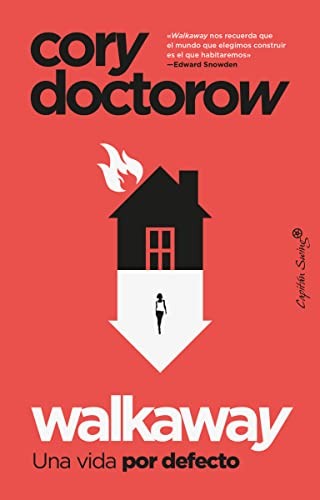
Paperback, 560 pages
Gaztelania language
Published April 16, 2017 by Capitán Swing.
Hubert Vernon Rudolph Clayton Irving Wilson Alva Anton Jeff Harley Timothy Curtis Cleveland Cecil Ollie Edmund Eli Wiley Marvin Ellis Espinoza (conocido por sus amigos como Hubert, etc.) era demasiado viejo para estar en esa fiesta comunista con su amigo Seth. Pero el desmoronamiento de la sociedad moderna exige formas creativas de diversión y de protesta, a pesar de la violencia y la hipervigilancia policial. Tras conocer a Natalie, una rica heredera que intenta escapar de las garras de su represivo padre, deciden renunciar por completo a la sociedad por defecto y marcharse. Después de todo, si cualquiera puede diseñar e imprimir las necesidades básicas de la vida —alimentación, ropa, refugio— desde un ordenador, hay pocas razones para formar parte del sistema. Sigue siendo un mundo peligroso, las tierras vacías destrozadas por el cambio climático, las ciudades muertas desmanteladas por la huida de las industrias, las sombras que esconden a …
Hubert Vernon Rudolph Clayton Irving Wilson Alva Anton Jeff Harley Timothy Curtis Cleveland Cecil Ollie Edmund Eli Wiley Marvin Ellis Espinoza (conocido por sus amigos como Hubert, etc.) era demasiado viejo para estar en esa fiesta comunista con su amigo Seth. Pero el desmoronamiento de la sociedad moderna exige formas creativas de diversión y de protesta, a pesar de la violencia y la hipervigilancia policial. Tras conocer a Natalie, una rica heredera que intenta escapar de las garras de su represivo padre, deciden renunciar por completo a la sociedad por defecto y marcharse. Después de todo, si cualquiera puede diseñar e imprimir las necesidades básicas de la vida —alimentación, ropa, refugio— desde un ordenador, hay pocas razones para formar parte del sistema. Sigue siendo un mundo peligroso, las tierras vacías destrozadas por el cambio climático, las ciudades muertas desmanteladas por la huida de las industrias, las sombras que esconden a los depredadores, tanto animales como humanos. Sin embargo, las filas de los andantes, que han dejado atrás el mundo ultracapitalistas, no dejan de crecer. Los centros de investigación ajenos al poder desarrollan entonces algo que los zotarricos no han conseguido nunca comprar. Y la vida por defecto cambia para siempre. Fascinante, inspirador y lleno de humor negro, Walkaway es un thriller de ciencia ficción multigeneracional que abre ventanas y arroja luz y propuestas ante los cambios fundamentales que viviremos antes de que acabe el siglo.
I really don;t know what to write about this book, a lot has already been written I'm sure. All I can say is: It's great, read it,
Buenas ideas, historia interesante y mala literatura. Ese podría ser el resumen de mis sensaciones con la lectura de esta novela, que se mueve entre el solar y el cyberpunk.
Doctorow plantea un futuro terrible para la humanidad que, sin embargo, deja un amplio hueco de esperanza gracias sobre todo a una tecnología asombrosa que permite la vida eterna. También me ha gustado mucho la idea de postescasez, aunque no justifica bien de qué manera los zotarricos son capaces de ejercer su dominio capitalista en un entorno en el que los alimentos y los objetos básicos se pueden imprimir sin más. En este sentido, la novela está llena de ejemplos de buenas ideas en cuanto a la ciencia ficción, mejor o peor descritos.
La trama no está mal, es una aventura que genera interés en el lector, pero donde falla es en el oficio literario a la hora de desarrollarla. …
Buenas ideas, historia interesante y mala literatura. Ese podría ser el resumen de mis sensaciones con la lectura de esta novela, que se mueve entre el solar y el cyberpunk.
Doctorow plantea un futuro terrible para la humanidad que, sin embargo, deja un amplio hueco de esperanza gracias sobre todo a una tecnología asombrosa que permite la vida eterna. También me ha gustado mucho la idea de postescasez, aunque no justifica bien de qué manera los zotarricos son capaces de ejercer su dominio capitalista en un entorno en el que los alimentos y los objetos básicos se pueden imprimir sin más. En este sentido, la novela está llena de ejemplos de buenas ideas en cuanto a la ciencia ficción, mejor o peor descritos.
La trama no está mal, es una aventura que genera interés en el lector, pero donde falla es en el oficio literario a la hora de desarrollarla. El autor tiene los típicos defectos de escritor mediocre, que se revelan sobre todo en los interminables diálogos de los personajes, que son utilizados como altavoz de las ideas del autor. Es imposible que alguien tenga semejantes conversaciones en la vida real, si es que hasta parecen ensayos. Y esto ya es personal, pero utilizar varias páginas para detallar pormenorizadamente una escena sexual es algo bastante poco elegante, y hay unas cuantas. Me ha gustado, eso sí, que los romances retratan una gran diversidad en cuanto a su orientación y género.
Es inevitable comparar esta novela con Los Desposeídos, la obra maestra de Ursula K. Le Guin. Las dos son novelas que proponen un sistema anarquista alternativo a la barbarie humana del futuro apocalíptico; pero mientras Ursula deja que sus ideas se filtren de una manera elegante entre una literatura de gran calidad, Cory nos las tira a la cara de una manera burda y poco estética.
Al final es el rollo de siempre: a mí no me basta una buena historia, de hecho creo que es lo que menos importa; quiero que lo que leo resuene en mí con toda la fuerza de las letras.
Walkaway embaces the idea of non compliance and co-operation, building a better future by leaving the trappings of capitalism behind. It's distinctly post-capitalist novel, which makes a strong effort to embrace anarchist ideals. Some of those ideals extend beyond the now, and a lot of the ideas are really quite big. It also presents some really uncomfortable questions and ideas, that don't necessarily sit easily. Walkaway starts on the idea of walking away from objects and things, but gradually starts exploring the idea of walking away from your own identity. I'm not entirely sure if some of those questions were intentional, but they left me pondering for days at the end of the book.
Well done.
Walkaway by @pluralistic@mamot.fr has been described as a utopian novel in a sea of dystopian alternatives, although I'd say it's actually both utopian and dystopian. It takes place in the 'middle distance' of the future; cars are still a thing, and they have wheels that roll on the ground, space travel isn't really a thing yet - humankind is essentially still bound to the Earth. But number of current-day issues have reached their logical culmination; from mundane technology (drones everywhere, 'interface surfaces' stuck to things instead of touch-screen smartphones, 3D printer 'fabs' are ubiquitous, capable of printing machines, clothing, and food) to the Big Issues of our time: Social inequality is extreme, with the overwhelming majority of the populous trapped in a struggling middle-class of insecure wage slaves, ruled by a tiny over-class of 'zottas', the hyper-rich owners of everything, from real estate, through business and roboticized industry, to intellectual …
Walkaway by @pluralistic@mamot.fr has been described as a utopian novel in a sea of dystopian alternatives, although I'd say it's actually both utopian and dystopian. It takes place in the 'middle distance' of the future; cars are still a thing, and they have wheels that roll on the ground, space travel isn't really a thing yet - humankind is essentially still bound to the Earth. But number of current-day issues have reached their logical culmination; from mundane technology (drones everywhere, 'interface surfaces' stuck to things instead of touch-screen smartphones, 3D printer 'fabs' are ubiquitous, capable of printing machines, clothing, and food) to the Big Issues of our time: Social inequality is extreme, with the overwhelming majority of the populous trapped in a struggling middle-class of insecure wage slaves, ruled by a tiny over-class of 'zottas', the hyper-rich owners of everything, from real estate, through business and roboticized industry, to intellectual property - Thomas Picketty's "Capital in the 21st Century" taken at its word. In addition, climate change has raised sea levels, flooding major cities, and pollution has rendered others unlivably toxic - great swathes of civilisation lie abandoned and in ruins.
At this intersection of technological advancement an eco-social catastrophe, three initial protagonists, Hubert, Seth, and Natalie decide to become "walkaways", joining a 'post scarcity' movement that rejects the premises of the materialistic, hierarchical, and clearly unsustainable "default" civilisation they find themselve in, and, rather than resisting or trying to change it, they simply 'walk away', leaving behind possessions, the very idea of ownership, money, work, and social status. The walkaways have no formal structure or organisation, are simply a collection of people living ideologically and literally outside civilisation. They occupy abandoned land and using 'fabbers', FAQs, and software, construct machines, buildings, and everything else they need, using 'feedstock' scavenged from the surroundings. Designs and systems are open-sourced and constantly improved on by whoever wants to work on them. Similarly work that needs doing on their pop-up settlements, from construction to food preparation, is picked up by whoever wants to do it, helped and highlighted by ubiquitous smart technology, all powered by wind and sun.
The trio wander and learn the walkaway terrain, make friends and lovers, with imminent disaster always looming - from internal philosophical conflicts and power struggles to increasingly lethal incursions from the "default" world, which sees the walkaways as more and more of an existential threat. They discover a community of scientists working on the ultimate act of walking away - the abandonment of biological dependency; developing the means to 'scan' the important parts of a person from their neurological structure, and 'sim' them on a digital substrate - i.e. upload minds into computers, making not only material but also temporal scarcity irrelevant. The walkaways want to eliminate death, and they want to open-source it so that everyone, not just the zotta overlords, can enjoy the benefits of disembodied immortality.
As so much good science fiction is, the novel is essentially a vehicle for Doctorow to explore philosophical ideas and take them to logical conclusions. Much of the dialogue is essentially 'Socratic'; two or more characters ostensibly 'arguing' about something, as a means for the author to explore a particular set of opposing philosophical positions. The topics are wide-ranging. 'Open-source' development and organisation feature large in the walkaway world; putative meritocracies are examined through a couple of different lenses: the zotta's, personified by Natalie's father, believe themselves to have floated to the top of society by their own genius, rather than their privilege, but also the walkaways themselves debate about their own social organisation, and whether work gets done more efficiently when 'merit' is rewarded by formal kudos or by the privilege of having exclusive right to particular work. In a nice twist, those with merit are labelled 'snowflakes', an epithet currently reserved for 'bleeding-heart liberals' by the 'right' in the real world, but used in Doctorow's world to apply to decidedly right-wing capitalists and others who feel their talents grant them divine rights not shared with commoners.
The 'mind-brain' problem (complete with oriental room), of course, is given an airing, along with some discussion of the possible socio-political consequences of widespread immortality. Interestingly, although mass abandonment of biology, and social control via fear becoming impossible, are projected as the outcome of mind-uploading, these scenarios don't actually play out in the novel, and the reasons aren't directly explicated.
However, rather than have the characters duke out all the issues raised, some of them are simply 'givens' in the walkaway universe; economic inequality, the militarised police state, anthropogenic environmental catastrophe. The injustices of these have terrible consequences in the story, but they're not 'solved' by it, and this is the dystopian facet of the work. Its utopia, on the other hand, is represented by ascent of the walkways, from an underground, marginal movement, through increasing persecution as their numbers and relevance swell, to finally (and possibly too sweetly) they become the 'default' themselves, by sheer force of numbers (and of course the efficiency, justice, and 'rightness' of their way of life).
Along the way, there are lots of opportunities to explore both neat and terrible technology, including realistic extrapolations from the state of the art, and actually real (if currently less ubiquitous) things, some interesting uses, and drawbacks to, #cryptography, changes of social norms around drugs, sexuality, gender, and race. And Doctorow gets to air many of his memes - individuals failing to recycle their way out of global warming; only those who tread water against all odds surviving shipwrecks, economists being to the 1% as court astrologers were to kings...
For me it was just the right mix of the familiar with some new ideas; allowing this reader to both feel like he knows some things, but also have some new thoughts too. I imagine it would be a vindicating romp for faraday-cage-wallet-toting, gait-altering, #cyanogenmod-installing, #cypherpunk githubbers everywhere.
The only thing wrong with it is that you can't put it down. Not even if it's 3am. This is why I can't read novels - they're the original Netflix binge-watching recipe for sleep deprivation.
i really wish someone got Doctorow an editor and deleted the sex scenes
I've enjoyed other Cory Doctorow books, Little Brother and Homeland both were good, the snippets for Walkaway had me hoping it would improve upon the area I didn't like in his previous books, which are the long explaining dialogues. Unfortunately Walkway doubles down on this format making it really difficult I abandoned all hope and stopped reading about 30% in.
The initial chapter was ok, but the main characters name "Hubert, Etc" is a bit awkward to read, and is so overused it's in practically every sentence. I almost stopped then it was quite annoying, but I was able to train myself to just start skipping over it.
There is a definite odd things going on with names, probably intentional, but makes it hard to read. There is a running "gag" with one character using the wrong name, ever single time, and it got called out and corrected every single …
I've enjoyed other Cory Doctorow books, Little Brother and Homeland both were good, the snippets for Walkaway had me hoping it would improve upon the area I didn't like in his previous books, which are the long explaining dialogues. Unfortunately Walkway doubles down on this format making it really difficult I abandoned all hope and stopped reading about 30% in.
The initial chapter was ok, but the main characters name "Hubert, Etc" is a bit awkward to read, and is so overused it's in practically every sentence. I almost stopped then it was quite annoying, but I was able to train myself to just start skipping over it.
There is a definite odd things going on with names, probably intentional, but makes it hard to read. There is a running "gag" with one character using the wrong name, ever single time, and it got called out and corrected every single time. It felt quite unnatural. A later chapter would be all pronouns and hard to figure out who's talking to who, especially with 4 people in the scene (2 men, 2 woman).
I feel that is the issue with the book, it just doesn't feel natural, the premise and world seem interesting but I couldn't continue with the writing. Such long sermons explaining everything, a simple question like why should I put this there, turns into 10 pages diving deep into social theories. Doctorow's other books had some of the same explaining, but the characters were developed a bit more and there was more story and plot.
I'm glad I bought it to support the author, his other two books I downloaded via open source, but the others I've read of his our much better.