Haunting and Prescient
5 stars
Parable of the Sower was published in 1993, and takes place in 2024. The dystopian world Butler paints in this book is so close to our current reality it’s eerie .
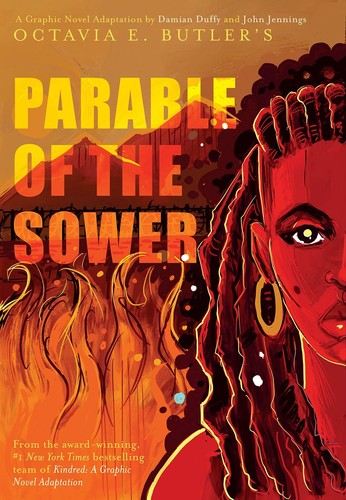
Published Aug. 8, 2020 by Abrams ComicArts.
Parable of the Sower is a 1993 science fiction novel by American writer Octavia E. Butler. It is an apocalypse science fiction novel that provides commentary on climate change and social inequality. The novel follows Lauren Olamina in her quest for freedom. Several characters from various walks of life join her on her journey north and learn of a religion she has crafted titled Earthseed. In this religion, the destiny for believers is to inhabit other planets. Parable of the Sower was the winner of multiple awards, including the 1994 New York Times Notable Book of the Year, and has been adapted into a concert and a graphic novel. Parable of the Sower has influenced music and essays on social justice. Parable of the Sower is the first in an unfinished series of novels, followed by Parable of the Talents in 1998.
Parable of the Sower was published in 1993, and takes place in 2024. The dystopian world Butler paints in this book is so close to our current reality it’s eerie .
It's certainly not a fun book, but it's extremely engaging, despite the bleakness of the slow-apocalypse setting and story.
What makes this apocalypse so horrifying, and the story so engaging, is how matter-of-fact Lauren is in describing everything in her diary. It's the world she grew up in, so it's normal to her, though she can see clearly even at 14 that it's unsustainable. There's a sharp generational divide between those who remember what things were like before, but all that is just history to her.
Lauren's present is hopeless and brutal, but her diary doesn't linger on the ever-present brutality like a horror novel would. She acknowledges it, of course, but she's focused on how to survive it so she can build something better.
The setting resonates so well today in part because the societal fears of the 1980s that Butler was extrapolating from are the same fears that …
It's certainly not a fun book, but it's extremely engaging, despite the bleakness of the slow-apocalypse setting and story.
What makes this apocalypse so horrifying, and the story so engaging, is how matter-of-fact Lauren is in describing everything in her diary. It's the world she grew up in, so it's normal to her, though she can see clearly even at 14 that it's unsustainable. There's a sharp generational divide between those who remember what things were like before, but all that is just history to her.
Lauren's present is hopeless and brutal, but her diary doesn't linger on the ever-present brutality like a horror novel would. She acknowledges it, of course, but she's focused on how to survive it so she can build something better.
The setting resonates so well today in part because the societal fears of the 1980s that Butler was extrapolating from are the same fears that have been re-stoked to create our modern political moment, and the problems she focused on remain unsolved. (I go into a bit more literary analysis on my website if you're interested in that sort of thing.)
I’m just 20% in and the events going on in this story describe the realities of today, even the months in 2025 are about right, too close for comfort. Scary…
This is such a strong story and great storytelling. I frequently found myself inspired by it to reflect on how we as individuals and communities may cope with our world. Can wholeheartedly recommend! #FediBooks #Solarpunk
I read this in April and have been thinking about it often since then. It helped me predict the outcome of the US elections and understand a lot of what goes on politically around the world.
The novel has its flaws but it does two things really well: show how people tend to react in the face of fundamental change such as climate change (mostly by denial and hoping for a return of the good old times) and drive home the point that there is no neutral ground in a burning world. I also found the reflections about change very compelling and think that if people followed them, i.e. accepted and shaped change, we would probably all be better off. The two main flaws of the book for me were the relentless grimness which I couldn't take quite seriously all the time - less would have been more in this …
I read this in April and have been thinking about it often since then. It helped me predict the outcome of the US elections and understand a lot of what goes on politically around the world.
The novel has its flaws but it does two things really well: show how people tend to react in the face of fundamental change such as climate change (mostly by denial and hoping for a return of the good old times) and drive home the point that there is no neutral ground in a burning world. I also found the reflections about change very compelling and think that if people followed them, i.e. accepted and shaped change, we would probably all be better off. The two main flaws of the book for me were the relentless grimness which I couldn't take quite seriously all the time - less would have been more in this case - and the depiction of drug users and the consequences of drug use. Those reminded me of those over the top "say no to drugs" cartoons of my childhood. Fitting because the book was written roughly at the same time. I'm wary of recommending this book because it's so grim and comes with all the content warnings but you should probably read it.
Great vision of where we could easily find ourselves in the year 2024. Though things haven't (yet) turned out as bad as envisioned in the book, it definitely hits close to home. Was nice to read a pre-post apocalyptic (what to you call it when the apocalypse is ongoing?? Just apocalyptic?) novel that didn't have zombies everywhere. I enjoyed the elements of religion and thinking about how one would start a new religion that wasn't as laden with hundreds of years of doctrine and dogma as what we have now.
The best "post-apocalyptic" story I've ever come across. So good, it puts most of the others to shame. Also just a great story on its about community, religion, and how to believe in and work for a better world. I wish it was recommended reading in school.
Which feels like a cheesy thing to say in a review about dystopian fiction, but I genuinely didn't realize this book was published in the year 1993 until I read Butler's biography at the back and realized she passed away in 2006. It feels... pertinent
Others have said this is a pretty grim novel. I agree. It hurt to read, quite often. I feel like I've mostly moved out of my dystopian fiction era but this one hooked me a lot harder than most I've read. I haven't finished a book this quickly in quite a while.
I think Parable of the Sower has a lot to say about eco-fatalism, as well as the many "fatalisms" of neoliberalism in general, which it delivers on very well. I also felt like it would have a lot to say about the value of religion, divorced from the way people in my life …
Which feels like a cheesy thing to say in a review about dystopian fiction, but I genuinely didn't realize this book was published in the year 1993 until I read Butler's biography at the back and realized she passed away in 2006. It feels... pertinent
Others have said this is a pretty grim novel. I agree. It hurt to read, quite often. I feel like I've mostly moved out of my dystopian fiction era but this one hooked me a lot harder than most I've read. I haven't finished a book this quickly in quite a while.
I think Parable of the Sower has a lot to say about eco-fatalism, as well as the many "fatalisms" of neoliberalism in general, which it delivers on very well. I also felt like it would have a lot to say about the value of religion, divorced from the way people in my life and I suspect many others in the west tend to equate religion with Christianity. It delivered on the former part, but not so much the latter in my opinion. Still very compelling, and very well written nonetheless.
Cuando estaba más joven la ficción y la ciencia ficción eran espacios que me hacían sentido para conectar con la imaginación y con la posibilidad de pensar y sentir la vida fuera de límites que percibía en mis presentes.
Como estos ámbitos de la literatura no resonaban tanto en algunas de mis redes cercanas, me alejé un poquito de éstos por algunos años y me metí a libros más teóricos y "serios". Pero desde que empecé a leer a Octavia Butler, por recomendación de una amiga, volví a interesarme en textos de (ciencia) ficción.
Octavia reflexionó sobre la ausencia/invisibilización de mujeres negras en un contexto donde predominaba una ciencia ficción de escritores hombres y blancos. También propuso escenarios que abordaran los pasados-presentes-futuros y que estimularan la imaginación y la creatividad como posibilidades ante las crisis que seguimos viviendo.
En Parable of the sower, Octavia tejió temas como: sensibilidad hacia otrxs …
Cuando estaba más joven la ficción y la ciencia ficción eran espacios que me hacían sentido para conectar con la imaginación y con la posibilidad de pensar y sentir la vida fuera de límites que percibía en mis presentes.
Como estos ámbitos de la literatura no resonaban tanto en algunas de mis redes cercanas, me alejé un poquito de éstos por algunos años y me metí a libros más teóricos y "serios". Pero desde que empecé a leer a Octavia Butler, por recomendación de una amiga, volví a interesarme en textos de (ciencia) ficción.
Octavia reflexionó sobre la ausencia/invisibilización de mujeres negras en un contexto donde predominaba una ciencia ficción de escritores hombres y blancos. También propuso escenarios que abordaran los pasados-presentes-futuros y que estimularan la imaginación y la creatividad como posibilidades ante las crisis que seguimos viviendo.
En Parable of the sower, Octavia tejió temas como: sensibilidad hacia otrxs seres; críticas al capitalismo, a las desigualdades socio-económicas, a la explotación y hacia la crisis climática; formas de construir relaciones y comunidades basadas en el reconocimiento mutuo; cercanías y comprensiones diversas con la tierra y la sostenibilidad de la vida (entre muchas otras cosillas).
Algo que me parece muy curioso, es la manera en que Octavia toma aspectos del libro, que como lectora me estuvieron haciendo cierto ruido de forma muy sutil, y los hace evidentes en la secuela (Parable of the talents). Creo que no es sencillo plantear todo un imaginario y luego construir una narrativa que lo replantee o que muestre sus matices, al menos de forma convincente. Por eso, aunque Parable of the sower es un libro que aprecié haber leído, verlo de la mano con Parable of the talents fue aún más apreciable para mí.
Both right-wing and left-wing preppers will find something for them in this book. Written from the POV of a teenager in a life-or-death situation, the book is pretty much on survival mode the entire time, with the accompanying lack of nuance and fear permeating throughout. Still, seems like an important and balanced read.
If you have the stomach to read a book about how to survive an apocalypse right now, this is a banger. As created literary religions go, Earthseed is better than most, and Lauren Olamina is just such a well-written, thoughtful character.
This was the first of what will certainly be many books by Octavia E. Butler in my TBR list. My copy (2019 reissue with great foreword by NK Jemisin) was a gift from @leahlove@mastodon.world and I thank her for it!
Like Jemisin, I'm sure this book will mean different things to me each time I read it, but two things fascinated me on this read. First, the view of a belief system at its origin reminds us that before such beliefs are collective or cultural, they are individual. Ultimately, their essence and purpose is to help each of us make sense of the world, so in truth, there are as many religions or belief systems as there are people (and probably more, in truth).
Second, I love that Butler endowed the protagonist with a quality that could be a superpower or could be a disability. Through Lauren, Butler explores with …
This was the first of what will certainly be many books by Octavia E. Butler in my TBR list. My copy (2019 reissue with great foreword by NK Jemisin) was a gift from @leahlove@mastodon.world and I thank her for it!
Like Jemisin, I'm sure this book will mean different things to me each time I read it, but two things fascinated me on this read. First, the view of a belief system at its origin reminds us that before such beliefs are collective or cultural, they are individual. Ultimately, their essence and purpose is to help each of us make sense of the world, so in truth, there are as many religions or belief systems as there are people (and probably more, in truth).
Second, I love that Butler endowed the protagonist with a quality that could be a superpower or could be a disability. Through Lauren, Butler explores with us how it can be both -- which can lead us to reflect on other qualities (in ourselves and others) that we assume to be one or the other.
I did not feel invested in any of the characters, but I did find them, their stories, and the setting very interesting. In that way I feel conflicted about this book. Another thing is that I was always expecting things to get worse in the next chapter, as the protagonist realizes early on, so I was anxious about continuing before I would read each time. But because I didn't feel invested in the characters, as shocking as the events were I wasn't too bothered by them.
Me deja un poco frío la idea de religión como sustituto del resto de las instituciones sociales en un tiempo apocalíptico, y no acabo de ver qué papel juega la hiperempatía en todo esto, si es mero atrezzo o un elemento verdaderamene importante. Lo veremos en el volumen dos.
Desde luego es un terreno de juego completamente diferente del de Xenogénesis.
On a second read, I feel a lot differently than I did the first time around. I can't separate uncomfortable feelings of reading about a teenager basically starting a cult and attracting people who are at their absolute most vulnerable to join. It doesn't sit well with me to read about Lauren's glee to "raise babies in Earthseed." And the intense, intense, dehumanization and otherizing of people using drugs, making them into physically unrecognizable monsters, is something I can't get past. If Lauren has hyper-empathy, and is more sensitive to people in need of help, then why does the buck stop with people using drugs?