Aimee Gunther reviewed Rakesfall by Vajra Chandrasekera
ok, so I legit can't do books with folks moving through different lifetimes
3 stars
Same issue with Cloud Atlas... Couldn't pay close enough attention to keep the strands.
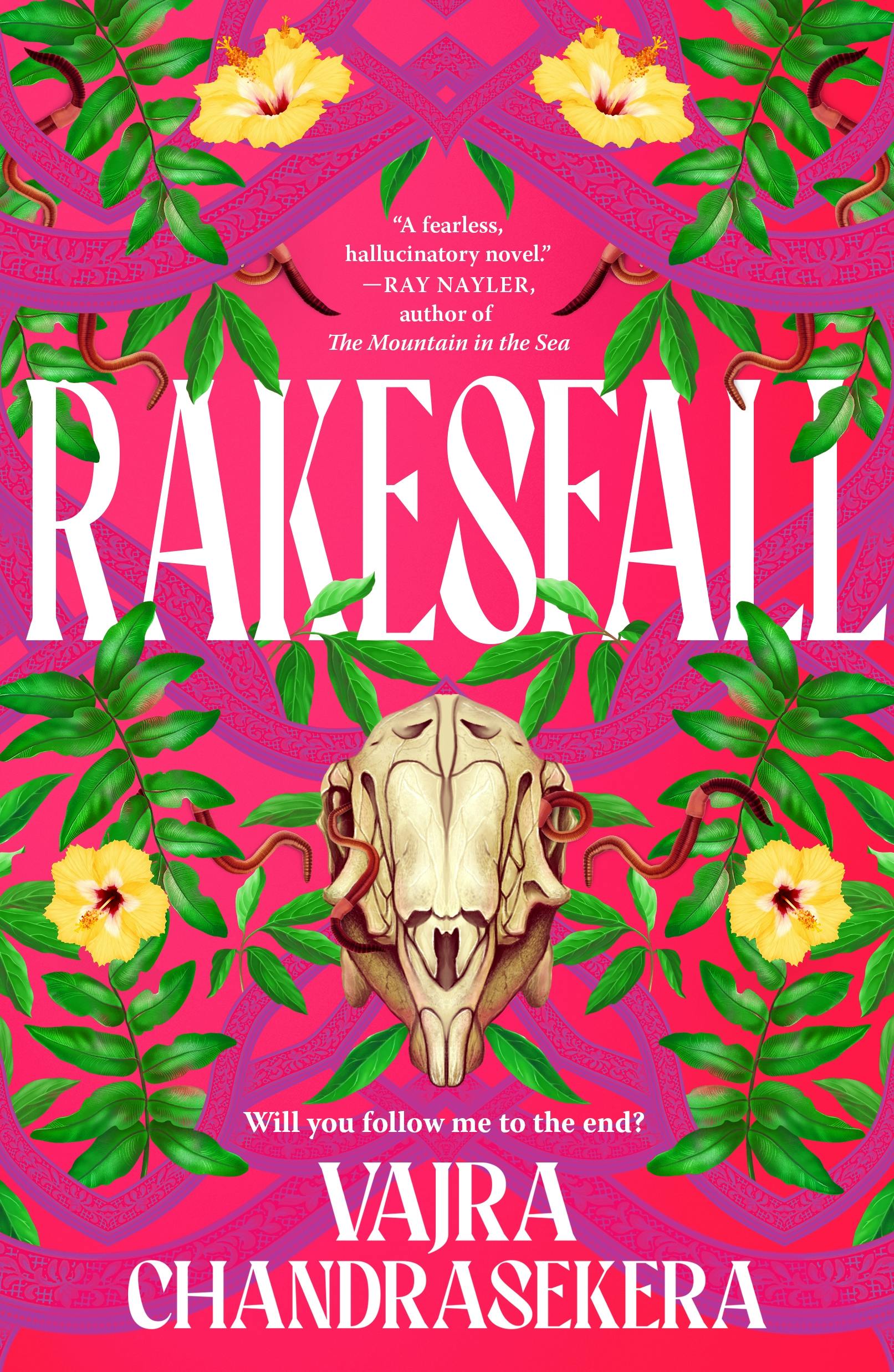
Hardcover, 304 pages
English language
Published June 18, 2024 by Tordotcom Publishing.
Rakesfall is a groundbreaking, standalone science fiction epic about two souls bound together from here until the ends of time, from the author of The Saint of Bright Doors.
Some stories take more than one lifetime to tell. There are wrongs that echo through the ages, friendships that outpace the claws of death, loves that leave their mark on civilization, and promises that nothing can break. This is one such story.
Annelid and Leveret met as children in the middle of the Sri Lankan civil war. They found each other in a torn-up nation, peering through propaganda to grasp a deeper truth. And in a demon-haunted wood, another act of violence linked them and propelled their souls on a journey throughout the ages. No world can hold them, no life can bind them, and they'll never leave each other behind.
Tracing two souls through endless lifetimes, Rakesfall is a virtuosic …
Rakesfall is a groundbreaking, standalone science fiction epic about two souls bound together from here until the ends of time, from the author of The Saint of Bright Doors.
Some stories take more than one lifetime to tell. There are wrongs that echo through the ages, friendships that outpace the claws of death, loves that leave their mark on civilization, and promises that nothing can break. This is one such story.
Annelid and Leveret met as children in the middle of the Sri Lankan civil war. They found each other in a torn-up nation, peering through propaganda to grasp a deeper truth. And in a demon-haunted wood, another act of violence linked them and propelled their souls on a journey throughout the ages. No world can hold them, no life can bind them, and they'll never leave each other behind.
Tracing two souls through endless lifetimes, Rakesfall is a virtuosic exploration of what stories can be. As Annelid and Leveret reincarnate ever deeper into the future, they will chase the edge of human possibility in a dark science fiction epic unlike anything you've read before.
Same issue with Cloud Atlas... Couldn't pay close enough attention to keep the strands.
Rakesfall is a work of art, it requires experience in order to appreciate it. This is not a novel I will gift to friends that are not deep into Sci-Fi.
I was able to grasp that I was looking at something beautiful, but I needed the final chapter to understand much of what Vajra Chandrasekera was aiming at.
Rakesfall proposes a cosmology that integrates mythology and technology. It involves possession, gods, demons, time travel and a multiverse, and it takes us all the way from colonial history to the heat death of the universe.
Yet, it is very much a novel of our time, of the powerful, the greedy and corrupt who wish to attain godhood and those who will oppose them.
I've put off talking about this book for a bit because honestly I'm not sure where to start. The short of it was that this was one of the best things I've read this year.
It is nearly impossible to describe the plot, but this is not a plot-driven book. It's weirder and bolder and chewier than The Saint of Bright Doors. To describe it at all, this is a book about two (ish???) characters whose various lives intertwine with each other across the timeline(s???), told in a series of simultaneously deeply interconnected but also wildly different stories. There's constantly recurring thematic motifs and threads, and I feel like the reader is asked to do a lot of work to try to connect the myriad of interconnected bits and bobs and hints in its various depths. I finished it and immediately considered starting again with my extra knowledge to try …
I've put off talking about this book for a bit because honestly I'm not sure where to start. The short of it was that this was one of the best things I've read this year.
It is nearly impossible to describe the plot, but this is not a plot-driven book. It's weirder and bolder and chewier than The Saint of Bright Doors. To describe it at all, this is a book about two (ish???) characters whose various lives intertwine with each other across the timeline(s???), told in a series of simultaneously deeply interconnected but also wildly different stories. There's constantly recurring thematic motifs and threads, and I feel like the reader is asked to do a lot of work to try to connect the myriad of interconnected bits and bobs and hints in its various depths. I finished it and immediately considered starting again with my extra knowledge to try to piece more connections together and better understand the whole.
Tonally, I also think Rakesfall is doing very interesting things. In comparison, The Saint of Bright Doors had some funny side jokes like "nine-tenths of the lore" in the same way that Harrow the Ninth has "none house, with left grief"; they're references if you catch them, but feel like a drive-by joke and not the destination. On the contrary, Rakesfall surgically deploys out of place phrases and tonal shifts to make impacts that deliberately jar the reader.
I apologize for pasting a number of quotes, but it astounds me a little that all of these things can be in the same book, that otherwise has a much more serious tone. I don't list these quotes as examples of what most of the prose is, but as examples of the rare places it swerves to.
The simile of the two-handed saw is not a parable. It isn't even a story. That it is self-consciously a simile suggests an unseriousness, a little haha hoho, a little lol j/k.
This is a one-off line in a brief section of the story that takes place in the same world as The Saint of Bright Doors (although you do not need to have read that book for this story).
Everybody on stage is silent and motionless for another few minutes. The AUDIENCE grows restless. Somebody in the audience takes a picture--the flash is blinding--even though there was a sign at the door that said NO PHOTOS, NO SMARTPHONES. There are muttered complaints. Imiya blinks. His pupils are huge.
Devakarti returns to the chorus and starts organizing them to move on to their next lives.
There's a chapter that is written like a script for a play, but is also a play in progress, and also includes dead people in the chorus who were killed by people in the play. This is a microcosm of what the book feels like.
All his soldiers pee themselves a little, so the king calls up his favourite wrestler, biggest face in the city, beloved far and wide as the best good guy who isn't afraid of anything, and the king says, my Beloved Bro, will you Please take this Cup of Water out unto the Dread Cemetary and give it to that Loud Fucker, and Tell him to (a) Pipe down and (b) give Thanks to the generosity of his King? And the wrestler says Sure Thing, my King. He is also frightened but he goes anyway, and he tells himself, real courage isn't found in not being afraid but in doing things that when you are, which just goes to show that after years of celebrity he is so deep in character that his internal narrative takes the voice of an Educational Programme for the small children who are his biggest fans and buy all his T-shirts.
There are other stories within stories in this book, but this one is told in this amazing style of an incredibly informal fable that was striking.
All of this makes for the kind of risky style that could be intensely irritating or obnoxious if it wasn't done so effectively. I think it works for me and I'm delighted by it; more, I think the choice to do this fits in this hurricane of a story that mixes and remixes characters and themes to such a degree.
A “dark science fiction epic” dealing with “the connectedness of all struggle against oppression” from Vajra Chandrasekera? Sign me the hell up. If the publisher is doing ARCs, I hope I am the first consideration.